Why JTM Hydroponics?
Experience and attention to detail
JTM Greenhouse optimization
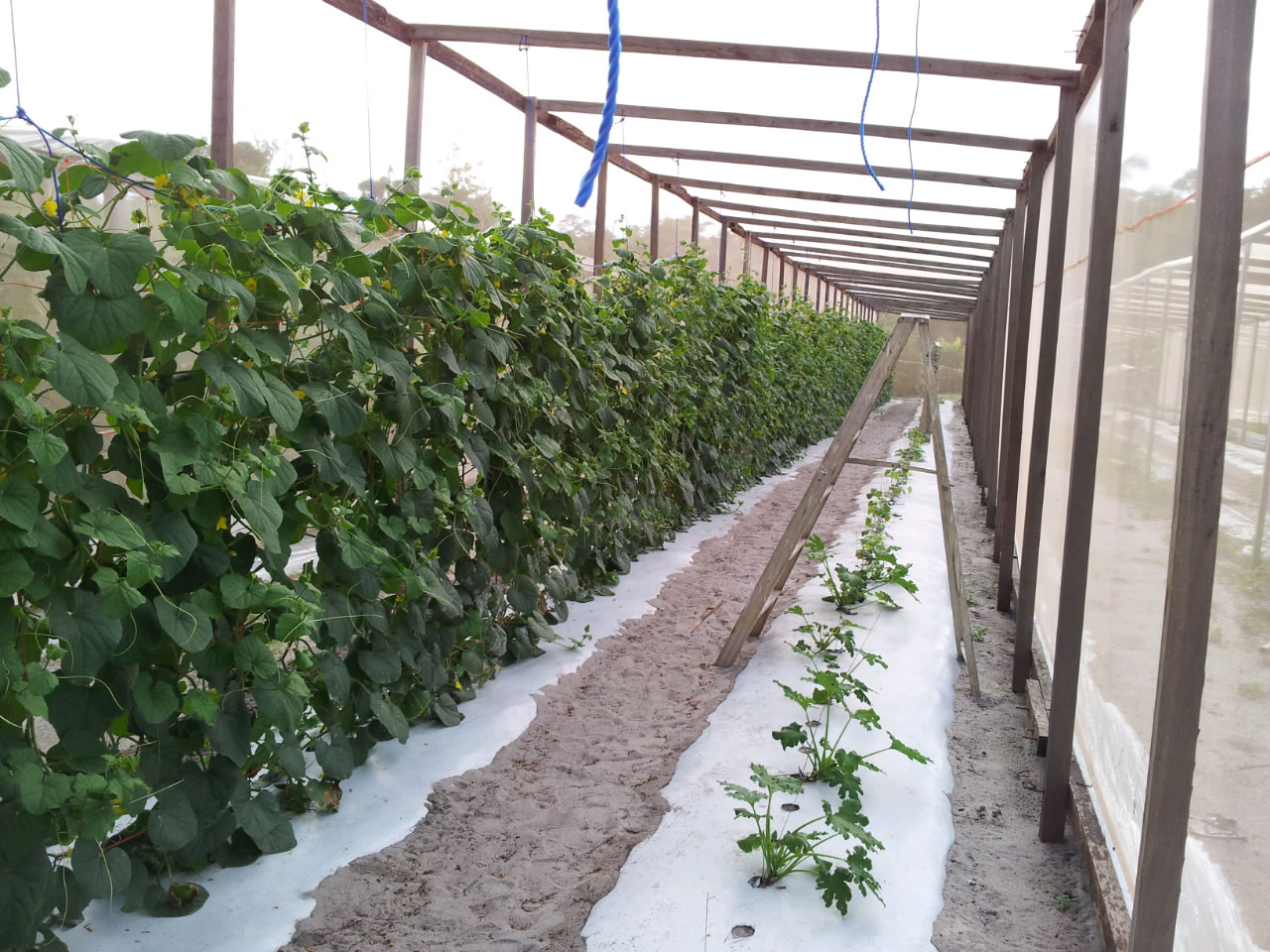
- Many greenhouse designs were evaluated over seven years and the most suitable greenhouse for Guyana’s environment was identified.
- The JTM greenhouse roof plastic has been chosen specifically to work in Guyana’s hot humid environment. Several different materials were tested over seven years and the one that was chosen has both IR and UV protection while providing excellent photoactive light transmission and longevity at a competitive price.
- The frame of the JTM greenhouse is made of wood. Several wood species were tested over seven years and only one was found to survive the high greenhouse humidity without rapid rot. The wood profile and frame spacing are optimized for cost and strength as well as friction fatigue on greenhouse mesh and plastic. The height width and slope of the frame are optimized for heat and humidity control as well as cost, ease of construction, and multi crop suitability.
- Multiple types of greenhouse mesh were evaluated over seven years and the mesh size is a fine balance between air flow and pest exclusion. The mesh is also optimized for initial cost vs. longevity.
- Irrigation pipe is crop specific. The pipe diameter, slope, coating, hole diameter and hole spacing have all been evaluated for each crop and optimized for cost, root space requirements, yield and disease prevention.
- Five brands of irrigation pumps were evaluated for water flow, initial price, operating cost, longevity and parts availability.
- Several timing devices were evaluated and only one is suitable to Guyana’s electrical grid requiring no blackout protection.
- JTM has developed a drought sensor to combat the single greatest risk in hydroponic farming, cessation of nutrient flow.
JTM Greenhouse culture
JTM’s hydroponic culture was adapted to Guyana’s environment of constant high temperature and humidity. Other factors evaluated over seven years were: yield, quality, shelf life, post harvest handling, transportation, marketing, distribution, operating cost, available labor force, temperature and humidity extremes, day length, light deprivation during monsoon season, cultivars, greenhouse specific pests and diseases to name just a few. Optimization of these factors have resulted in an economically viable, finely tuned system of agriculture that works well in all weather and across a wide crop range.
Cultivar (specific variety of a particular crop)
Multiple cultivars of each crop have been evaluated over twelve years. Each cultivar chosen has been evaluated for yield, quality, seed availability, shelf life, customer acceptance, growth rate, labor requirement and disease resistance to greenhouse specific pests and diseases.
Seedlings
High yielding hybrid cultivars can be temperamental and will only germinate properly under very specific conditions. Seedlings are very delicate and have very specific nutrient and environmental requirements.
Pesticides
Many pesticides have been researched and evaluated over twelve years and many non toxic yet highly effective pesticides, like soap and baby oil, have been identified.
Fertilizers
Hydroponic fertilizers are extremely complexed and finely tuned combinations of minerals. These fertilizers are so complicated that software has been created for their design. Only extensive testing can reveal which fertilizers actually provide adequate nutrition while maintaining correct pH and mitigating toxicities.
Advances
New cultivars are continually created and old cultivars fall out of production. Cultural advances continue while many viable techniques remain hidden in the incomprehensibly large knowledge base we call the internet. In order to stay competitive, testing of cultivars and cultural techniques must continue.